Podcasts
Tune in to the podcasts created and contributed to by our academic staff in Archaeology and History. From interviews with our very own staff members in EXplaining History to the intricacies of Churchill's Finest Half Hour, there is plenty to explore.
Check back regularly for upcoming episodes and recent releases.
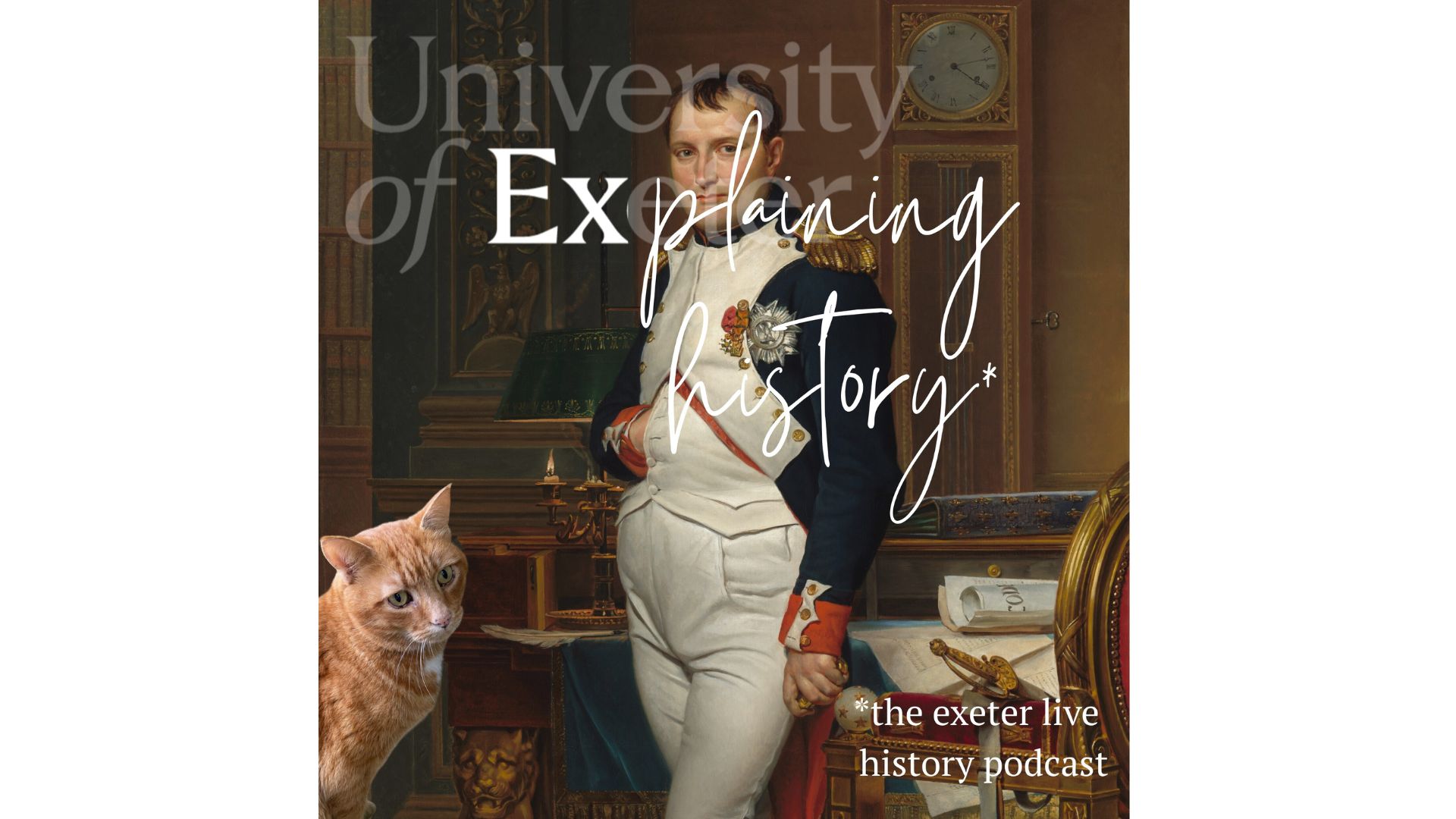
EXplaining History
In this live episode, The Rest Isn't History at Exeter invites Dr Gemma Clark (Senior Lecturer, Modern History) to take us through her past work on the Irish Civil War, on writing the history of violence, and on how our identities as historians can shape our work (and careers!) in sometimes unexpected ways. Gemma reveals some of her new work on arson and fire as forms of political violence, and our host John Lidwell-Durnin learns about turf missiles and the negative consequences of offering to sell butter to the police. Don't miss this episode! Thanks so much to Digital Humanities at the University of Exeter for hosting and recording.
This very special live episode of EXplaining History features a discussion exploring the exciting new work of Dr Gregory Lippiatt on the political and social consequences of the Albigensian Crusade, exploring how state and religious powers negotiated the heretic worlds that developed in the south of France in the 12th century (listeners excited to be entertained with proper hellfire and the invocation of demons will have to be contented with the popularisation of veganism-- but how could veganism invoke such dangers for church authority? Dr Lippiatt explains all). Listeners interested in Pennsylvania will be fascinated to discover that John and Gregory both grew up in the keystone state, and they compare childhood experiences of exploring historical PA sites from Gettysburg to the underground Benjamin Franklin Museum.
Today we’re very lucky to be joined by Kalathmika Natarajan, who has just published a must-read intervention in migration history: Coolie Migrants, Indian Diplomacy: Caste, Class and Indenture Abroad, 1914–67 – Get a copy here! Kala is Lecturer in South Asian History, and in this conversation she takes us through the entanglement of emigration, indenture, and diplomacy in 20th century India. We discuss indentured labour in Ceylon, the appearance of Hindu missionaries in the Caribbean, and the decisive influence of caste. We had to cut this one a little short due to the sudden recollection that we both had to teach.
Churchill: The Finest Half Hour
Winston is Back Episode 1 - In this new podcast, international experts Professor Richard Toye and Dr. Warren Dockter explore the career of a giant of 20th century history - British Prime Minister and statesman Sir Winston Churchill.
The podcast dives straight into the most momentous years in Churchill's long and dramatic life, beginning with the outbreak of war with Nazi Germany in September 1939, an event which saw Churchill recalled from the political wilderness to take charge of the Royal Navy.
Winston is Back Episode 2 - In the second episode of this new podcast on the dramatic life of Winston Churchill, Professor Richard Toye and Dr. Warren Dockter explore the military and political crises which propelled Winston Churchill into office as Britain's Prime Minister.
How was it that a disastrous operation against the Nazis in Norway came to benefit Churchill, when as the minister in charge of the Royal Navy, he bore primary responsibility for the fiasco? We'll reveal that Churchill himself couldn't quite understand...
Disaster and Defiance Episode 1 - Professor Richard Toye and Dr. Warren Dockter explore the drama of Churchill's first days as Prime Minister - dominated by the shock German invasion of western Europe and military disaster for the Allies.
Disaster and Defiance Episode 2 - As the Allied armies fight for survival in France, Winston Churchill faces a battle inside his own Cabinet. Because the Foreign Secretary wants to explore what peace terms the Nazis might offer...
Disaster and Defiance Episode 3 - Professor Richard Toye and Dr. Warren Dockter explore the context and the impact of what's become one of most famous speeches in modern history. When despite weeks of military setbacks, Winston Churchill pledged that Britain would never give in to Hitler.
But when Churchill said "We shall never surrender", did "We" actually mean Britain and France?
Disaster and Defiance Episode 4 - It's early June 1940. Though the Nazi invasion of France continues to progress at speed, Winston Churchill remains determined to keep France in the war.
Professor Richard Toye and Dr. Warren Dockter discuss whether, when Churchill said "We shall never surrender", he was actually referring to Britain and France.
And they explore Churchill's frantic efforts to sustain morale within the French government, making two dramatic flights o France in 48 hours.
Disaster and Defiance Episode 5 - The extraordinary story of how Churchill threw his weight behind a last-ditch attempt to keep France in the war against the Nazis - by joining the British and French nations together to form the "Franco-British Union".
And the story of how this daring plan crashed and burned...
Disaster and Defiance Episode 6 - Professor Richard Toye and Dr. Warren Dockter discuss the reaction to the fall of France in June 1940 - and how Winston Churchill responded with what would become one of the most momentous speeches in modern history.
Disaster and Defiance Episode 7 - Professor Richard Toye and Dr. Warren Dockter discuss a decision which Winston Churchill called"the most hateful, the most painful and unnatural in which I have ever been involved." Namely the order to attack French warships at Mers-el-Kebir in Algeria, following the armistice between France and Nazi Germany.
They explore the background to the attack - and how Churchill explained and justified the move, one which bolstered his political position in Britain and improved Britain's standing in the US.
Disaster and Defiance Episode 8 - Professor Richard Toye and Dr. Warren Dockter look at how Churchill galvanized the British war effort in the summer of 1940 - and how he expressed his belief that the fight against the Nazis must be a truly national effort, in a radio address where he spoke of "The War of the Unknown Warriors".
The Prime Minister and the President Episode 1 - "No lover ever studied every whim of his mistress as I did those of President Roosevelt."
So Winston Churchill remembered his efforts to secure material support from the United States in the 18 months between taking office as Prime Minister and the Japanese attack on Pearl Harbor which brought America into the Second World War.
Professor Richard Toye and Dr. Warren Dockter explore the nuances and fascinating details of this courtship as President Roosevelt navigated domestic resistance to entering a European war. They discuss the Atlantic Conference of August 1941 and its careful presentation to Roosevelt and Churchill's domestic audiences. And Churchill's reaction to the news of Pearl Harbor.
The Prime Minister and the President Episode 2 - Professor Richard Toye and Dr. Warren Dockter chart the beginnings of the wartime alliance between the United States and Great Britain and the birth of the "special relationship".
They begin with Churchill's visit to Washington in December 1941, his major speeches to the US Congress and the Canadian Parliament and follow the dealings between America's
President Franklin Roosevelt and British Premier Winston Churchill as the new allies fight to turn the tide of the war during 1942.
The Prime Minister and the President Episode 3 - How was it decided that only Germany's unconditional surrender would end the war in Europe?
How did Winston Churchill make the case for the 'Germany First' strategy in the US Congress?
What happened when the Allies' 'Big Three' - Roosevelt, Churchill and Stalin - met for the first time at the Tehran Conference of 1943?
And when did Winston Churchill realise that Britain was now a junior partner alongside the two emerging superpowers. the USA and the USSR?
Professor Richard Toye and Dr. Warren Dockter address these questions and more in this edition of Churchill: The Finest Half Hour.
The Prime Minister and the President Episode 4 - Dr Warren Dockter and Professor Richard Toye discuss the last eighteen months of the relationship between British Prime Minister Winston Churchill and US President Franklin D. Roosevelt.
They highlight the tensions leading up to 'Operation Overlord' - the Allied invasion of France carried out despite Churchill's preference for a continued attack through southern Europe.
They explore the significance of the Yalta Conference in February 1945, when FDR, Stalin and Churchill - by now very much a minor figure relative to the leaders of the emerging superpowers - met to hammer out the future of Europe.
Finally, the look at Churchill's eulogy in the House of Commons following President Roosevelt's death in April 1945. Was this speech, as some observers have suggested, lukewarm in its praise of FDR? Can we see in it any evidence that the relationship between the two leaders was less friendly than four years of newsreel coverage had suggested?
The Soundbite of the Century Episode 1 - Eighty years ago - on 5 March 1946 - Winston Churchill made what would be one of the most consequential speeches of the 20th century. Assessing post-war Europe claimed that "From Stettin in the Baltic to Trieste in the Adriatic, an iron curtain has descended across the continent."
Professor Richard Toye and Dr. Warren Dockter assess the background to the speech, its political context and the messages of an address which Churchill actually called 'The Sinews of Peace'.
The Soundbite of the Century Episode 2 - Professor Richard Toye and Dr. Warren Dockter explore the immediate reaction to Churchill's 'Iron Curtain' speech of March 1946 - and its enduring legacy.
Outlining responses by everyone from members of the British public to Stalin (who denounced the speech in forthright terms), they show how an address made in a small town in Missouri echoed round the world.
They ask how a rallying cry for freedom was received by African-Americans, particularly when the speech was delivered to an all-white audience in a segregated state.
And they show how Churchill's phrase came to sum up the division of Europe, with the Soviet Union dominating "behind the Iron Curtain".
The Soundbite of the Century Episode 3 - The location of WInston Churchill's 'Iron Curtain' speech - Westminster College in Fulton, Missouri - is now the home of America's National Churchill Museum.
80 years on from the speech, Tim Riley, Director and Chief Curator of the Museum, talks to Prof. Richard Toye and Dr. Warren Dockter about how the museum came to be and how it commemorates not only Churchill's famous address but his long career as a politician, author - and sometime painter.
Young Man in a Hurry Episode 1 - Young Winston Churchill heads off to the frontier of India, intent on making his name as a war correspondent and soldier, entering a world of "fever, dysentery and bullets."